Trend Highlighter
Building a Real-time Link Aggregator for Farcaster
Note: This project has been archived.
1. Introduction
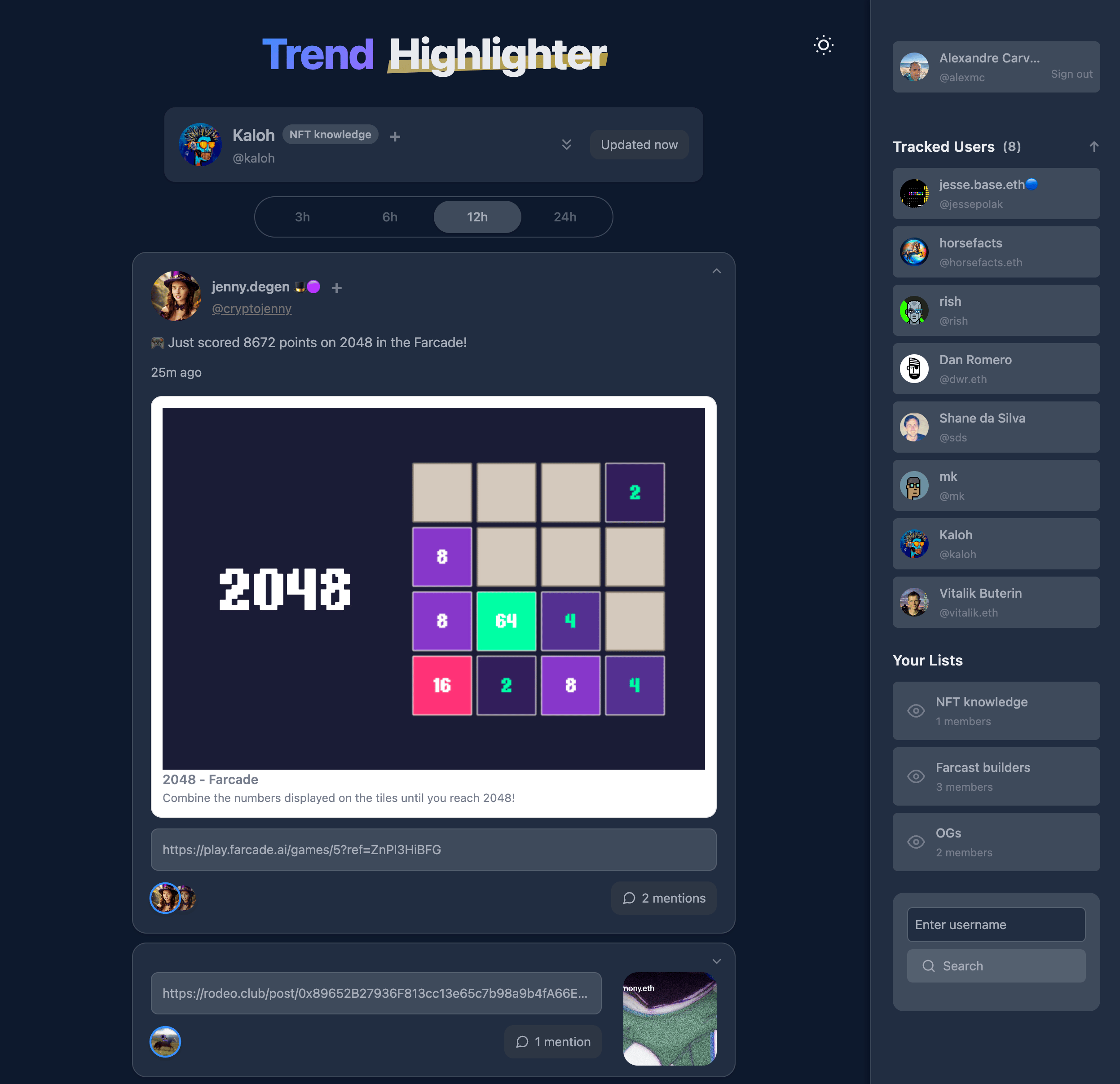
The Farcaster Trend Highlighter was a web application designed to surface the most relevant and trending content from the Farcaster social network. It addressed the challenge of information overload by aggregating and analyzing link-sharing patterns within user networks and custom groups.
Key challenges this project tackled:
- Real-time data collection and processing from the Farcaster network
- Efficient storage and retrieval of social graph data
- Intelligent content aggregation and trend detection
- Scalable background processing for continuous updates
2. Architecture Overview
The application was built on a modern stack designed for scalability and real-time processing. At its core, it utilized FastAPI, PostgreSQL, and Redis for caching and real-time data processing. The system was containerized using Docker, which ensured consistent deployment across environments.
A key architectural decision was the implementation of Celery for background task processing, allowing us to handle time-consuming operations like data synchronization without impacting the user experience. This was complemented by Prometheus monitoring, giving us insights into system performance and helping identify bottlenecks.
3. Core Technical Features
3.1 Efficient Data Collection
We used the Neynar API to fetch data from the Farcaster network. Our implementation used Redis for efficient caching, ensuring data freshness and reducing API calls (and costs).
3.2 Intelligent Content Processing
One of the most interesting challenges was implementing intelligent URL extraction and processing. Our system could identify and categorize different types of content, from simple text links to embedded media.
3.3 Real-time Updates
The real-time update system utilized a combination of background tasks and event-driven architecture. Celery workers continuously processed user timelines, while the main application maintained real-time connections with clients.
3.4 Performance Optimizations
Our performance optimization strategy focused on database query optimization, caching strategies, and efficient data structures.
4. Technical Challenges and Solutions
Throughout development, we encountered and solved several significant challenges:
- Implementing efficient rate limiting while maintaining data freshness
- Designing a scalable database schema for social graph data
- Building a reliable background processing system
- Managing cache invalidation across multiple services